

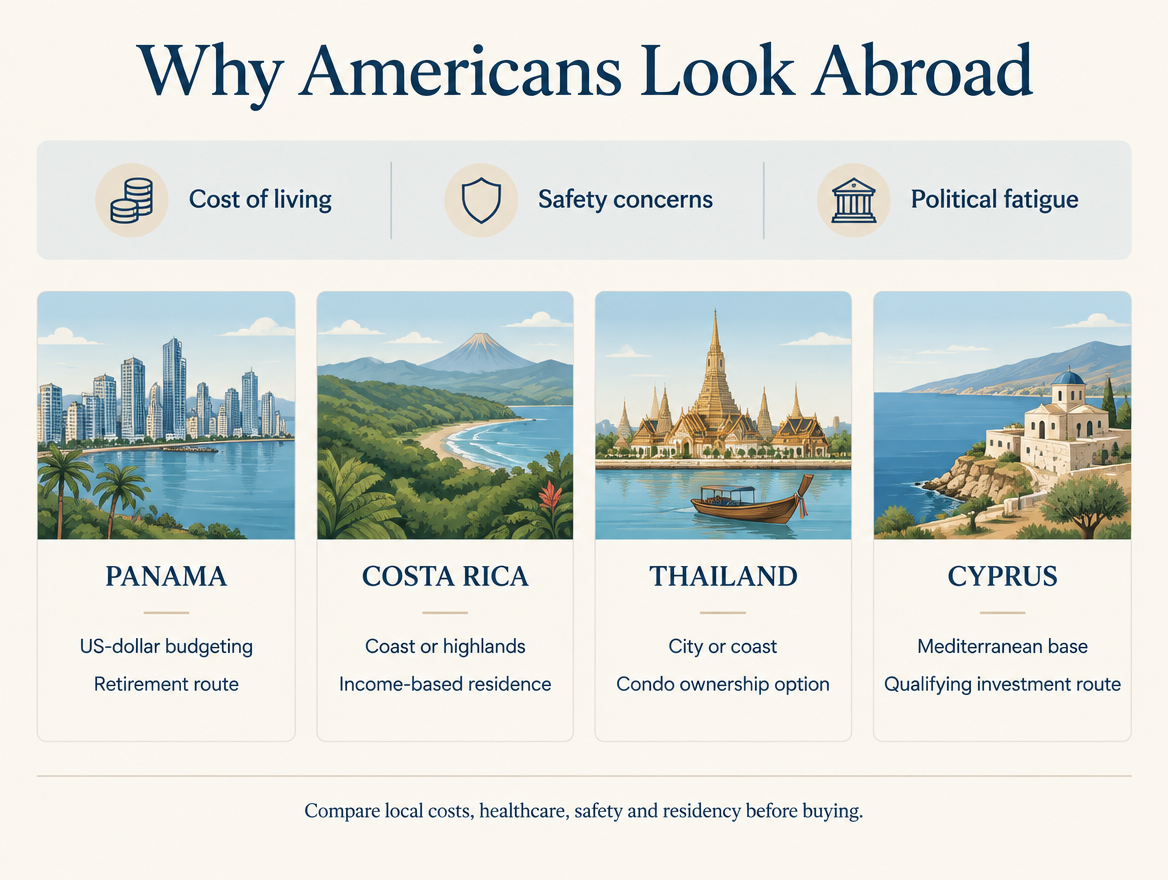
Why are Americans leaving the US? For most, it is not one dramatic event. It is the sum of a monthly budget that feels harder to control, concern about violence and safety, and the exhaustion of living in a society that can feel permanently divided. Gallup found in 2025 that about one in five Americans would like to move permanently to another country if they could. That measures aspiration, not actual departures. But it does explain why more people are asking what a different life might look like. Panama, Costa Rica, Thailand and Cyprus come up in those conversations for different reasons. The right question is not which country is “best”. It is which one works for your income, health needs, family and appetite for change.
Are Americans Actually Leaving, or Just Thinking About It?
Both things happen, but they should not be confused. Gallup’s survey asks whether people would move permanently if they had the opportunity. It does not count emigration, and it does not establish that Panama, Costa Rica, Thailand or Cyprus are the four leading destinations. Treat the figure as evidence of dissatisfaction and curiosity, not a forecast of a mass exodus.
What I do see in international property conversations is a shift in the first question. Buyers are less likely to ask only what an apartment will earn. They ask whether they could live nearby, what everyday life costs, how they would access healthcare and whether the place feels right after the holiday has ended.
Why Does the Cost of Living Push People to Look Abroad?
Housing, insurance, healthcare and ordinary household bills can turn a good income into a tight monthly budget. Pew found in 2025 that 73 percent of Americans viewed the affordability of healthcare as a very big national problem. US healthcare spending reached $15,474 per person in 2024, according to the Centers for Medicare & Medicaid Services; that is national spending, not the bill an individual pays.
A lower-cost destination can make retirement income or remote earnings go further, but the calculation has to be personal. Imported goods, international schools, private health cover, a car, flights home and property maintenance can erase an attractive headline comparison. A city-centre apartment and a home in a smaller town are different budgets in every country on this list. Before buying, price a normal month in the exact neighbourhood where you would live.
How Do Safety and Political Fatigue Fit In?
Safety is a legitimate part of the decision. In a 2025 Pew survey, gun violence was among the major national concerns Americans named. Politics adds another layer: in Pew’s 2023 research, 65 percent said they always or often felt exhausted when thinking about politics. For some households, moving abroad is a search for a calmer daily rhythm as much as a financial decision.
That does not mean any destination is automatically safer. Crime, road safety, natural hazards and access to emergency care differ by city and even by neighbourhood. Nor does moving remove politics from life. It changes the issues you have to learn. Visit more than once, speak to people who live there year round and check current local information before deciding.
Why Do Americans Consider Panama?
Panama is a practical first look for retirees who want to remain relatively close to the US. The country uses the US dollar alongside the balboa, which simplifies day-to-day budgeting for someone whose income is in dollars. Panama City offers a large urban market and international connections; smaller centres offer a different pace and often a different cost base.
Panama also has an established pensionado residence route. Its migration service publishes a minimum lifetime pension of 1,000 balboas a month for the standard route, with conditions and documents to satisfy. A property purchase is a separate decision. I would start by testing the climate and the neighbourhood, then ask a local immigration lawyer to check the residence path before treating any home as a solution to it.
Why Do Americans Consider Costa Rica?
Costa Rica appeals to people who want access to nature, an outdoor routine and a choice between coast, city and cooler highland communities. It is a good reminder that “moving to a country” is too broad a decision. A beach town and a Central Valley suburb will give you different weather, costs and access to services.
The country has pensionado and rentista residence categories. Its migration law sets income tests for each, so the route depends on the source and stability of your income. Popular expat areas can be expensive, particularly once housing, a vehicle and private healthcare are included. Rent first if you can, and see how the rainy season and the everyday journey to healthcare suit you.
Why Do Americans Consider Thailand?
Thailand offers a broad choice of lifestyle, from Bangkok’s convenience and private hospitals to Phuket’s coastal market and smaller northern cities. For a buyer, the key distinction is ownership. Foreigners can generally own a qualifying condominium unit freehold within the building’s foreign quota; land and villas require a different legal analysis. Our guide to buying a condo in Bangkok explains the property side.
There are several possible long-stay routes, including retirement visas with their own age, financial and insurance conditions. Do not assume buying a condo automatically gives you a visa. Check the current immigration route independently, then choose a property that makes sense even if the visa rules change. The heat, air quality in some areas, language and distance from family are as important as the asking price.
Why Do Americans Consider Cyprus?
Cyprus suits buyers who want a Mediterranean base with an established international community. Paphos and Limassol serve different budgets and daily routines: Paphos is generally the lower-priced, quieter option in our current range, while Limassol offers a larger business city and a broader high-end market. Our Paphos or Limassol comparison sets out what each budget buys.
Cyprus also has a property-linked permanent residence route for qualifying non-EU investors. The official investment criteria include a first-sale house or apartment from a developer worth at least €300,000 plus VAT, alongside other requirements. That permit is a Cypriot immigration status, not a right to live anywhere in the EU. Check the full criteria with a Cyprus lawyer before choosing a property for residency purposes.
Which Destination Fits Which Move?
- Panama: start here if dollar-based budgeting, proximity to the US and a retirement route are your priorities.
- Costa Rica: look here if you value nature and want to compare very different climates and communities before buying.
- Thailand: consider it if you want a wide choice of city or coastal living and are comfortable managing distance, visa rules and property ownership carefully.
- Cyprus: consider it if a European island base and a clear property shortlist matter more than the lowest possible monthly cost.
These are starting points, not rankings. No country is the least expensive or safest for every person. Your own income, medical needs, family ties and tolerance for bureaucracy will decide more than a listicle will.
What Should You Check Before You Move?
- Spend time in your chosen area outside peak holiday season, and rent before you buy if the location is new to you.
- Build a monthly budget that includes housing, health insurance, transport, taxes, maintenance and trips back to the US.
- Confirm your visa or residence route with a qualified local adviser; do not assume a home purchase gives you the right to stay.
- Speak to a US cross-border tax professional. US citizens remain subject to US tax rules on worldwide income while living abroad.
- Check your Social Security payment position for your destination and arrange health cover: Medicare generally does not cover care outside the US.
- Use an independent local lawyer to review title, contracts and ownership limits before paying a deposit.
Frequently Asked Questions
Why are Americans leaving the US?
People cite different combinations of cost, healthcare, safety, family and political fatigue. Gallup found that about one in five Americans in 2025 said they would like to move permanently if they could. That is a measure of interest, not the number who left.
Where are Americans moving abroad?
Americans live in many countries, and there is no single reliable ranking that makes Panama, Costa Rica, Thailand and Cyprus the top four. These four are useful options to compare because they offer different climates, distances from the US, costs and residence routes.
Is it cheaper to live in Panama, Costa Rica, Thailand or Cyprus than in the US?
It can be, but the answer depends on the specific town and your household. Housing, private healthcare, imported goods, school fees and travel back to the US can change the calculation. Price your own likely monthly spend before deciding.
Can I keep Social Security if I move abroad?
Many US citizens can receive Social Security while living overseas, but payment rules depend on the country and personal circumstances. Use the Social Security Administration’s Payments Abroad Screening Tool before you move.
Does Medicare cover me overseas?
Usually no, apart from limited exceptions. Arrange suitable local or international health cover and check the details with Medicare before you commit.
Does buying property abroad give me residency?
Sometimes a qualifying investment can support an application, as in Cyprus, but ownership and permission to live in a country are separate legal questions. Check the current rules with an independent local adviser before purchasing.
Talk to me first
If you are thinking about leaving the US, begin with the life you want to build, then find the property that supports it. Tell me your budget, whether this is a full move or a second home, and which places you are considering. I can help you compare the property options in markets where we work, including Thailand and Cyprus, and point you toward the right local specialists for the legal detail. Get in touch or message me on WhatsApp on +61 404 497 335.
About the author. Rick Flay has more than 30 years of experience in real estate, with over 1,000 properties sold and rented across international markets. Rick Flay International Real Estate helps clients buy, sell and relocate through an international network.
Property, tax, healthcare and immigration rules change, and the right decision depends on your circumstances. Nothing in this article is financial, legal, tax or immigration advice. Take independent professional advice before buying or moving.
© The data shown on this website and any other written communication has been offered by third parties and is assumed to be correct. The sale of the properties is managed by Rick Flay Real Estate, Australia. Our company does not guarantee their veracity or accept any responsibility for any errors. The offer may be subject to errors, price changes, omissions and/or withdrawal from the market without prior notice. Prior to purchase clients are advised to check with their legal advisors on all details pertaining to the sale/purchase. The information does not form any part of any contract for sale. We always recommend that you take independent, legal, financial and taxation advice. Additionally some photos, plans, specifications are indicative/illustrative only and may have been created by AI.




Join The Discussion