
Selling in a slower market is not the problem most vendors think it is. Australian owners are not being forced to sell. Arrears remain low and distressed listings sit near historic lows, so almost nobody is dumping property at any price. What has changed is on the buyer side. Higher interest rates have cut how much people can borrow, cost of living pressure and global uncertainty have made them cautious, and the result is simply fewer active buyers competing for each property. That does not mean your home will not sell. It means the two things you control, your asking price and your expectations on timing, matter far more than they did two years ago. Price it to the market you are actually in and it will sell. Price it to the market of 2024 and it will sit.
Why Has the Market Slowed?
Because buyers can borrow less and are more hesitant to commit, not because owners are being forced out.
The cash rate has sat at 4.35 percent since May 2026, and PropTrack has been explicit that higher interest rates continue to weigh on borrowing capacity and housing demand. When borrowing capacity falls, the same buyer who qualified for a certain figure last year simply cannot reach it now. Add cost of living pressure, a cautious economic outlook and global uncertainty, and buyers slow down.
The evidence for this being a buyer capacity story rather than a seller distress story is clear in the data. Cotality found that over the year to August 2026, values in the lower quartile of the market rose 10.8 percent while the upper quartile managed just 0.7 percent. PropTrack recorded the same pattern, with national unit prices up 3.0 percent against 1.5 percent for houses. Cheaper property is outperforming expensive property because that is what constrained buyers can still afford.
That is not a market losing confidence in property. It is a market where buyers have less to spend.
Are Sellers Being Forced to Sell?
No, and this matters for what you should expect. APRA data has put non performing home loans at around one percent, and Domain reported in February 2026 that distressed listings remained near historic lows across every capital city. The Reserve Bank has found that very few Australian loans sit in negative equity.
In other words, there is no wave of desperate sellers undercutting you. Most owners who cannot achieve their price simply withdraw and wait. That is good news for anyone selling properly, because it means you are not competing against panic. You are competing against a smaller pool of buyers, which is an entirely different problem and a much more manageable one.
What Does a Cautious Buyer Market Mean for Your Sale?
Two things change, and both are within your control.
- With fewer active buyers, the right one may take longer to appear. A property that would have sold in a fortnight in 2024 may reasonably take longer now, and that is normal rather than a sign anything is wrong.
- When buyers have less borrowing capacity, the price that attracts genuine interest is set by what they can actually pay, not by what a neighbour achieved eighteen months ago in different conditions.
Everything else, the presentation, the marketing, the quality of the buyer pool you reach, is what a good agent brings. But no amount of marketing fixes a price the market cannot reach.
What Actually Happens If You Overprice?
You usually end up with less money, not more. This is the part vendors most often get wrong, and it is worth understanding properly because it works against your instincts.
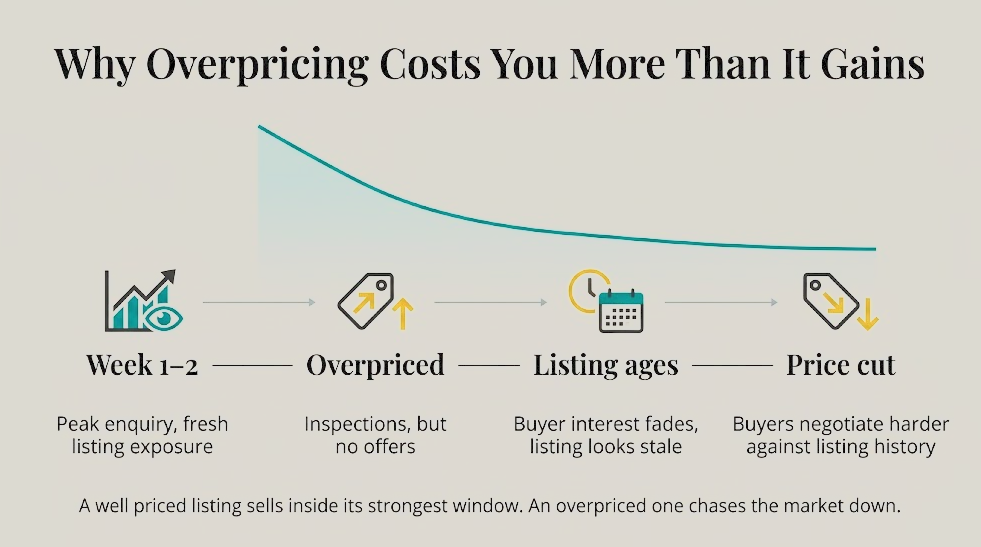
A new listing generates its strongest enquiry in the first few weeks. That is when your property appears in fresh search results, when the buyers who have been watching that suburb see it, and when interest is at its peak. Price it above what buyers can reach and you spend that window generating inspections but no offers.
After that, the listing ages. Buyers who saw it at launch have moved on. New buyers see a property that has been available for months and reasonably wonder what is wrong with it. By the time the price comes down to a realistic level, the property carries a history, and buyers negotiate harder against a listing that looks like it has struggled.
The result is a sale that takes longer, involves more price reductions, and frequently lands below what the property would have achieved had it been priced correctly from the start. Chasing the market down is the most expensive way to sell.
Does That Mean You Should Wait to Sell?
Not necessarily, and it depends entirely on your situation rather than on any general rule.
Worth remembering that if you are selling to buy again, you are transacting in the same market on both sides. A softer market means you may achieve less on the sale, but you also buy your next property under the same conditions, often with more choice and more room to negotiate as a buyer. For anyone moving up in price, that maths can work in your favour.
If you have no need to move and no timeframe, waiting is a legitimate choice. If you do have a reason to sell, whether that is relocating, downsizing, settling an estate or simply moving on, a realistically priced property still sells. The Australian market has not stopped. Prices nationally remain 1.8 percent higher than a year ago and 27.5 percent higher than five years ago, according to PropTrack.
How Do You Set a Realistic Price?
You start with evidence rather than hope. A realistic appraisal looks at what comparable properties have actually sold for recently, not what they were listed at, and factors in current buyer capacity, the specific condition and position of your property, and how much competing stock is on the market right now.
The uncomfortable truth is that an agent who quotes you the highest number is not doing you a favour. Some agents win listings by telling vendors what they want to hear, then spend the next three months conditioning them down to the number that was realistic on day one. You lose the launch window, the property goes stale, and the eventual price is lower than an honest appraisal would have delivered.
Talk to me first and I will give you a straight assessment, free and with no obligation. If the number is lower than you hoped, I will show you the evidence behind it. If it is higher, that is a good day for both of us. What I will not do is inflate a figure to win a listing, because it costs you money and it costs me a sale.
What Should You Do Now?
- Get a realistic appraisal based on recent comparable sales rather than an aspirational figure.
- Understand the buyer for your property. Constrained buyers are still active, but they are more sensitive to price and more thorough in comparison.
- Present the property properly. In a market with fewer buyers, the ones who do appear have more to choose from.
- Set a realistic timeframe from the outset so you are not making rushed decisions in week six.
- Reach beyond the local buyer pool where it makes sense. Interstate and international buyers widen the field, which matters more when the local field has thinned.
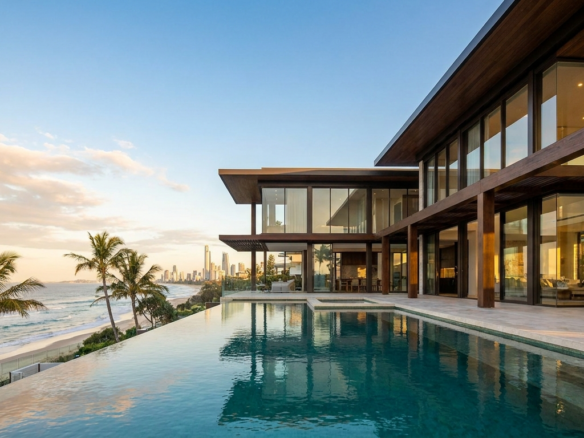
If you would like to see the calibre of property and buyers we work with, browse what is currently being marketed on the Gold Coast and in Brisbane, including this two bedroom apartment at The Palms in Surfers Paradise and this three bedroom sea view apartment in the same building.
Frequently Asked Questions
Is now a bad time to sell property?
Not inherently. Buyers are more cautious and there are fewer of them, so realistic pricing and a realistic timeframe matter more. Property that is priced to the current market continues to sell, and national prices remain higher than a year ago.
Why are there fewer buyers at the moment?
Higher interest rates have reduced borrowing capacity, and cost of living pressure alongside economic and global uncertainty has made buyers more cautious. PropTrack has pointed directly to higher rates weighing on borrowing capacity and housing demand.
Are Australian sellers being forced to sell?
Largely no. APRA has put non performing home loans at around one percent and Domain reported distressed listings near historic lows across every capital city in February 2026. Most owners who cannot achieve their price simply withdraw rather than sell cheaply.
What happens if I overprice my property?
You typically lose the launch window when enquiry is strongest, the listing ages, and buyers negotiate harder against a property that has been on the market a long time. Overpriced properties frequently sell for less than they would have if priced correctly from the start.
How long should selling take in the current market?
Longer than in the peak conditions of recent years, and it varies considerably by location, price bracket and property type. That is why an honest conversation about timeframe at the outset matters as much as the price itself.
How much does an appraisal cost?
Nothing. An appraisal is free and carries no obligation. You get an evidence based view of what your property should realistically achieve in the current market, and what you do with that is entirely up to you.
Talk to me first
Before you decide anything about selling, find out what your property is realistically worth today. It costs nothing, there is no obligation, and you will have an honest number based on evidence rather than a figure designed to win your business. Request a free appraisal and let us have a proper conversation about your options.
Book a meeting with Rick Here.
About the author. Rick Flay has more than 30 years of experience in real estate, with over 1,000 properties sold and rented across international markets. Rick Flay Real Estate works with an international network spanning South East Asia, Dubai, Europe, the USA, the UK and New Zealand, giving sellers access to buyers most local agencies cannot reach.
This article is general market commentary and is not financial, investment or legal advice. It does not take account of your personal circumstances. Always take independent legal, financial and taxation advice before making a property decision.
© The data shown on this website and any other written communication has been offered by third parties and is assumed to be correct. The sale of the properties is managed by Rick Flay Real Estate, Australia. Our company does not guarantee their veracity or accept any responsibility for any errors. The offer may be subject to errors, price changes, omissions and/or withdrawal from the market without prior notice. Prior to purchase clients are advised to check with their legal advisors on all details pertaining to the sale/purchase. The information does not form any part of any contract for sale. We always recommend that you take independent, legal, financial and taxation advice. Additionally some photos, plans, specifications are indicative/illustrative only and may have been created by AI.

Join The Discussion