
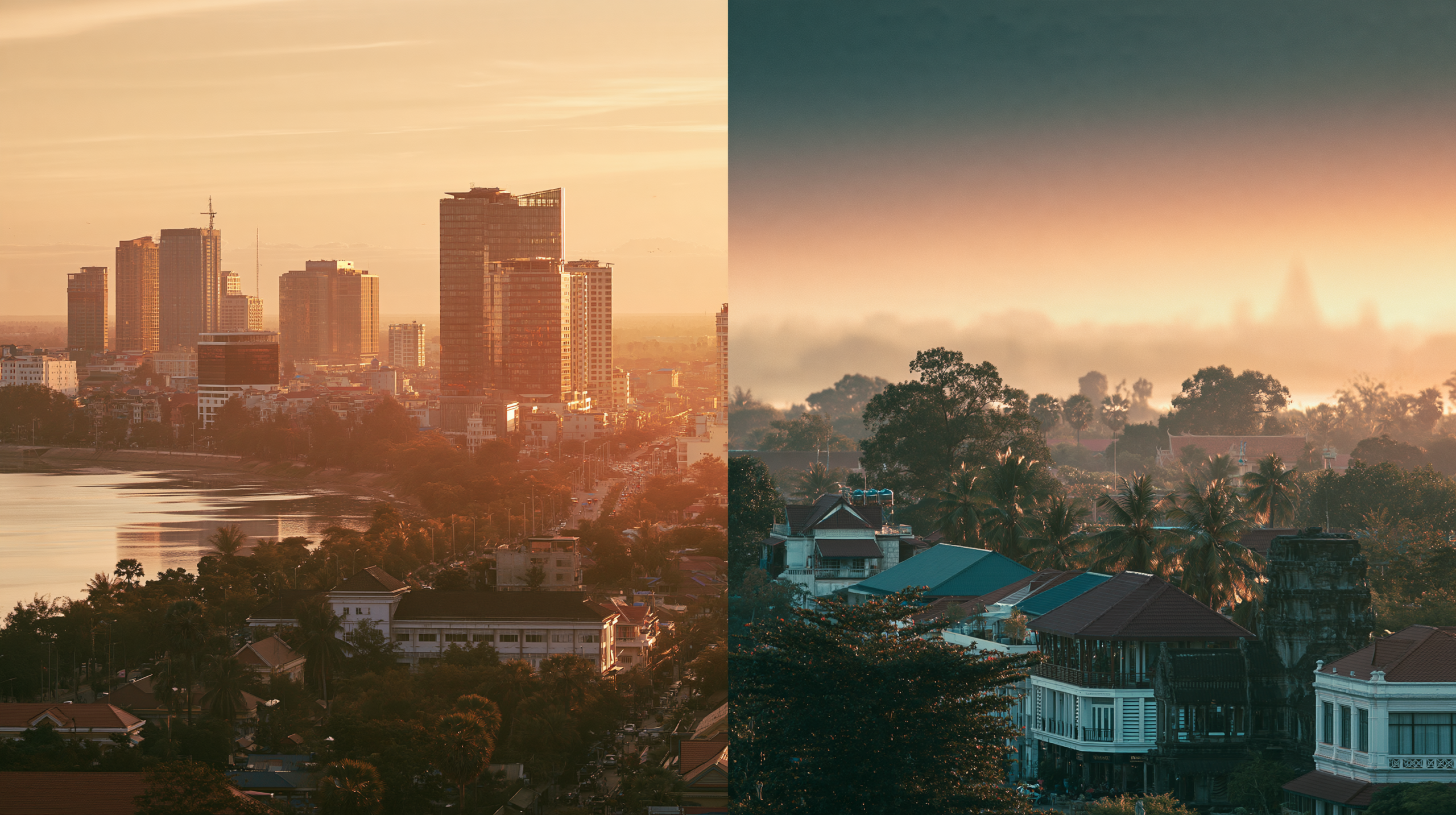
Cambodia is the next market joining our portfolio, and I expect to have properties in Phnom Penh and Siem Reap before the end of the year. It is worth knowing about now rather than when the listings appear, because it does several things that no other market in our range does at the same time. Foreign buyers own condominiums outright in their own name. The whole economy runs on US dollars, so there is no currency conversion to manage and no exchange rate eating your returns. Yields in central Phnom Penh are commonly reported ahead of Thailand and Vietnam. And entry prices start well below anything comparable in Bangkok or Bali. If that sounds like it belongs on your list, register your interest now and I will come to you first when the stock lands.
Why Cambodia, and Why Now?
Three reasons, and the first one surprises most people.
- It runs on US dollars. Cambodia is a dollarised economy. Property is priced in dollars, rent is collected in dollars and returns are paid in dollars. For anyone who has watched a currency move swallow a year of rental income elsewhere, that alone is worth a look.
- Yields are strong. Gross rental yields in prime central Phnom Penh are commonly reported in the range of 7 to 8 percent, with some sources citing higher in the best districts. Siem Reap is generally reported a little lower, at around 6 to 9 percent, driven by tourism.
- The entry price is low. Studios and one bedroom apartments in central Phnom Penh districts have been reported from around USD 60,000 to 80,000. That is below our entry point in Bangkok, which is itself the cheapest market we currently offer.
Getting in before a market is widely covered is usually where the returns are, and that is the opportunity here.
Can Foreigners Own Property in Cambodia?
Yes, outright, with some clear limits that are easy to work within once you know them.
Under Cambodia’s 2010 law on foreign ownership in co-owned buildings, foreign nationals can own condominium units under a strata title, registered directly in their own name with no local partner and no nominee. Two conditions apply: the unit must be on the first floor or above, not the ground floor, and foreign ownership across a building is capped at 70 percent.
Foreigners cannot own land, which rules out villas, townhouses and standalone houses in your own name. In practice this is the same position as Thailand, and it points foreign buyers toward exactly the stock that performs best for rental anyway.
Cambodia also has several title types, and the differences matter more here than in most markets. Strata and hard titles are the secure forms. Soft title, registered only at commune level, is weaker and worth avoiding. Knowing which you are being offered is the single most important check in a Cambodian purchase, and it is one of the reasons to buy through someone who does this properly.
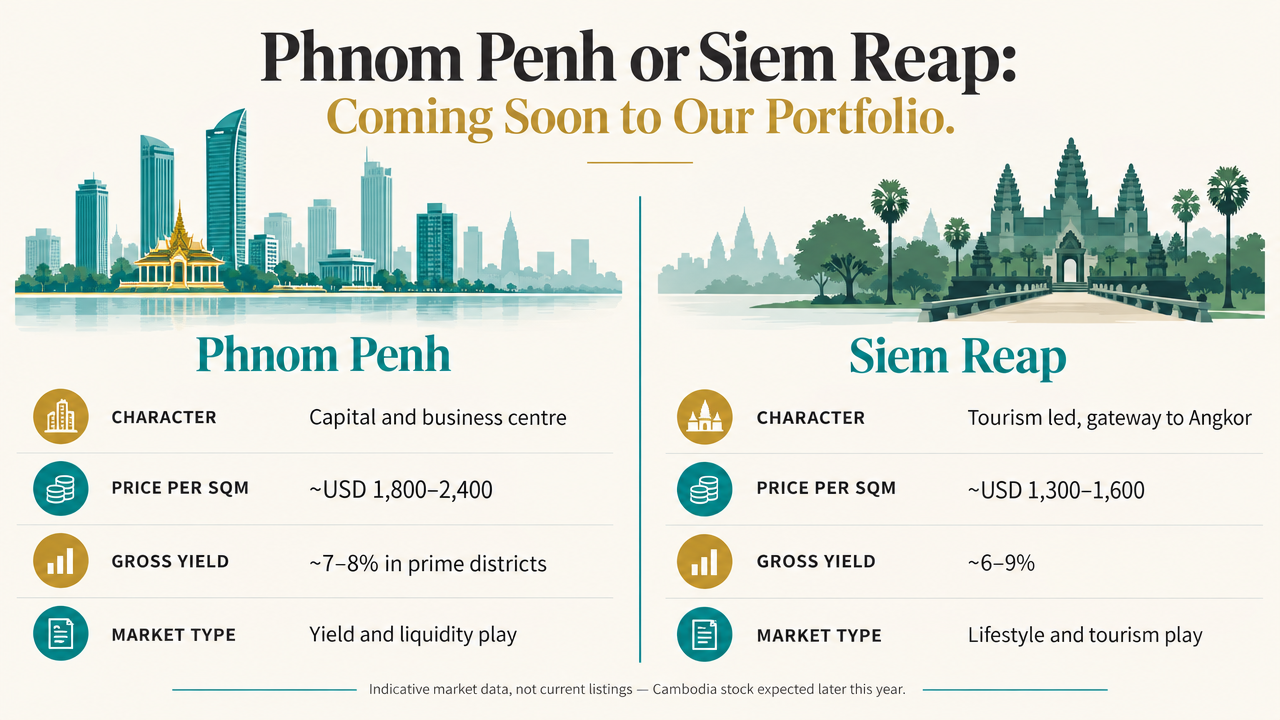
Phnom Penh or Siem Reap?
They suit different buyers, and the numbers show why.
| Character | Indicative price per sqm | Indicative gross yield | |
| Phnom Penh | The capital and business centre, deepest market for foreign buyers, strongest expatriate rental demand and resale liquidity | About USD 1,800 to 2,400 for upscale stock | About 7 to 8 percent in prime districts |
| Siem Reap | The gateway to Angkor Wat, a tourism led market with a smaller expatriate community and a lower entry price | About USD 1,300 to 1,600 | About 6 to 9 percent |
Figures are indicative market data drawn from published Cambodian property sources, not from our own listings, which are not live yet. Treat them as a guide to the opportunity rather than as pricing for a specific property.
In short, Phnom Penh is the yield and liquidity play, with a genuine business city behind it. Siem Reap is the lifestyle and tourism play, at a lower entry price, with the seasonality that comes with a tourist economy.
Can Buying Property in Cambodia Get You a Visa?
Not directly, and I would rather tell you that upfront than have you find out later.
Unlike Thailand, where a qualifying condo purchase supports a long stay route, buying a condominium in Cambodia does not by itself grant residency. What Cambodia does have is one of the simpler long stay systems in the region. The ordinary business visa and the retirement visa, the latter available from age 55, are both renewable indefinitely and cost a few hundred dollars a year.
So the honest position is this: Cambodia is not a buy a property, get a visa market. It is a market where long stay visas are straightforward and inexpensive on their own, and where owning a property gives you a reason and a base to use one. Requirements change, so I confirm the current position for anyone who intends to spend real time there.
What Happens Next?
I am in the process of securing stock in both cities and expect to have properties available before the end of the year.
Buyers who register now get told first. That matters more in a new market than an established one, because the best units in a launch tend to go before anything reaches a public listing page. If Cambodia is of interest, tell me which of the two cities appeals, roughly what you want to spend, and whether you are buying for yield or for somewhere to spend time.
Frequently Asked Questions
Can foreigners buy property in Cambodia?
Yes. Foreign nationals can own condominium units outright under a strata title, registered in their own name, provided the unit is above the ground floor and foreign ownership in the building stays within 70 percent. Foreigners cannot own land.
What rental yields does Cambodia offer?
Gross yields in prime central Phnom Penh are commonly reported around 7 to 8 percent, with Siem Reap generally reported at around 6 to 9 percent. These are indicative market figures rather than a guarantee on any specific property.
Is property in Cambodia priced in US dollars?
Yes. Cambodia is a dollarised economy, so property is bought, sold and rented in US dollars. There is no local currency conversion to manage and no exchange rate risk between the purchase price and the rent you collect.
Does buying property in Cambodia give you residency?
No. Unlike Thailand, a property purchase does not by itself support a visa. Cambodia does offer business and retirement visas that are renewable indefinitely and inexpensive, so long stays are straightforward, just not tied to the property.
Phnom Penh or Siem Reap, which is better?
Phnom Penh is the deeper market with stronger expatriate rental demand and better resale liquidity. Siem Reap has a lower entry price and a tourism driven rental market. Which suits you depends on whether you are buying for yield or for lifestyle.
When will Cambodian properties be available?
I expect to have stock in Phnom Penh and Siem Reap before the end of the year. Register your interest now and you will hear about it before anything goes on the website.
Talk to me first
Book a meeting with Rick Here.
Cambodia is early, which is exactly why it is worth a conversation now rather than in twelve months. Tell me which city interests you and what you are trying to achieve, and I will put the right opportunities in front of you as soon as they are available. Register your interest and you will be on the list before anything is published.
In the meantime, our guides to buying a condo in Bangkok and buying a villa in Bali cover the two markets closest to it in price and profile.
About the author. Rick Flay has more than 30 years of experience in real estate, with over 1,000 properties sold and rented across international markets. Rick Flay International Real Estate works with an affiliate network spanning more than 20 countries, helping clients buy, sell and relocate.
Ownership, tax and visa rules in Cambodia change, and the right approach depends on your circumstances. Nothing in this article is financial, legal or immigration advice. Always take independent professional advice, and insist on proper title verification before committing to any Cambodian property.
© The data shown on this website and any other written communication has been offered by third parties and is assumed to be correct. The sale of the properties is managed by Rick Flay Real Estate, Australia. Our company does not guarantee their veracity or accept any responsibility for any errors. The offer may be subject to errors, price changes, omissions and/or withdrawal from the market without prior notice. Prior to purchase clients are advised to check with their legal advisors on all details pertaining to the sale/purchase. The information does not form any part of any contract for sale. We always recommend that you take independent, legal, financial and taxation advice. Additionally some photos, plans, specifications are indicative/illustrative only and may have been created by AI.

Join The Discussion