

Selling Your Gold Coast Home in 2026: A Market Outlook for Vendors
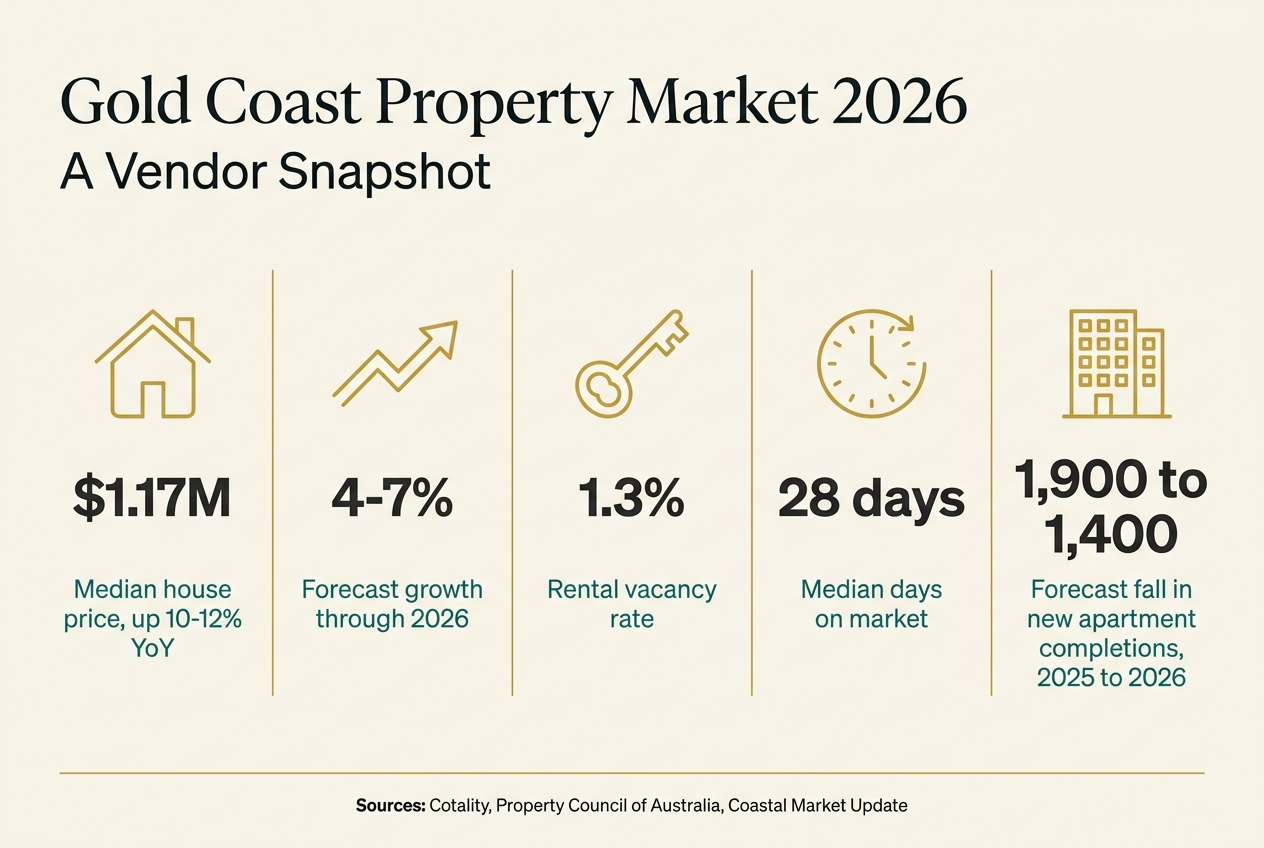
If you’re weighing up whether to sell your Gold Coast home in 2026, the short answer is that conditions still favour vendors, though the market has shifted from rapid growth into a steadier phase. Median house prices sit around $1.17 million, up roughly 10 to 12 percent over the past year according to Cotality data, and most major banks are forecasting a more moderate 4 to 7 percent growth through the rest of 2026. Demand is still ahead of supply. The city’s population continues to grow by tens of thousands of residents a year, while the Property Council of Australia has flagged that new apartment completions could fall from around 1,900 units in 2025 to just 1,400 in 2026. Vacancy rates are sitting near 1.3 percent, among the tightest in the country. For vendors, that combination of more buyers and fewer available homes generally supports a faster sale and a stronger price, provided the property is positioned correctly from the outset.
Is now a good time to sell on the Gold Coast?
By most measures, yes, though “now” looks different to how it did two years ago. After a run where many Gold Coast suburbs saw values more than double, the market has moved from a boom phase into what several local analysts are calling a post-boom plateau. Growth has slowed from the double-digit gains of 2024 and 2025, but there’s no widespread correction on the horizon. Vendors are still holding the advantage in most price brackets.
Properties are also moving faster than the long run average. Recent Gold Coast data puts the median days on market at around 28 days, compared with a long run average closer to 36. That gap matters if you’re timing a sale around a purchase elsewhere, or simply want certainty.
Performance varies significantly by suburb. Broadbeach and Burleigh currently hold the highest median house values on the coast, reflecting sustained demand for prestige coastal living, while more accessible corridors such as Ormeau and Oxenford are drawing buyers who’ve been priced out of the coastal strip. Where your property sits within that spread shapes both your pricing strategy and how long it’s likely to take to sell, which is exactly the kind of detail a proper appraisal accounts for rather than a generic online estimate.
What’s driving current buyer demand?
Three forces are doing most of the work. First, population growth. The Gold Coast continues to add tens of thousands of new residents each year, and that pressure shows no sign of easing. Second, constrained supply. Coastal land is largely built out, new apartment completions are falling rather than rising, and the South East Queensland Regional Plan calls for roughly 4,500 new dwellings a year, a target the region is not currently meeting. Third, infrastructure. Light Rail Stage 3 between Broadbeach South and Burleigh Heads is entering passenger service in mid-2026, and the first stage of the Coomera Connector opened in December 2025, both of which are lifting buyer interest in the suburbs they connect.
Together, these factors are also drawing a wave of interstate buyers, particularly from Sydney and Melbourne, who are relocating for lifestyle and comparative affordability even as Gold Coast prices climb. That interstate demand is layered on top of strong local upgrader and first home buyer activity, which is part of why well-presented, realistically priced homes are still attracting solid competition at open homes.
Does overseas buyer interest affect my sale price?
This is worth getting right, because the picture has changed recently. As part of the Federal Budget 2026-27, the Australian Government extended its temporary ban on foreign persons purchasing established residential dwellings, originally due to expire in March 2027, out to 30 June 2029. In practice, that means most Gold Coast homes, being established rather than newly built, currently cannot be purchased by foreign nationals at all.
That doesn’t mean overseas interest is irrelevant to your sale. The ban applies specifically to foreign persons. It does not apply to Australian citizens living overseas, permanent residents, or New Zealand citizens, all of whom can buy established property in the normal way. That’s a meaningfully different audience to the generic “international buyer” pitch you’ll see elsewhere, and it’s exactly where a genuinely global agent network earns its keep. Reaching Australian expats and permanent residents across markets like the UK, Southeast Asia and the Gulf, rather than marketing broadly to any offshore buyer, is what actually moves a Gold Coast listing in front of qualified, eligible buyers right now.
Book your appraisal
Every vendor’s situation is different, and the numbers above are a starting point, not a substitute for a proper look at your specific property and street. If you’re considering listing in the months ahead, get in touch (/contact/) for a current market appraisal, or explore recent Gold Coast sales and listings (/gold-coast/) to see how your suburb is tracking right now.
Frequently asked questions
How is my property valued?
A proper appraisal weighs recent comparable sales in your immediate area, current buyer demand for your property type, days on market trends, and any features or renovations that set your home apart. It’s a more accurate starting point than automated online estimates, which don’t account for condition, presentation or hyperlocal demand.
What does the selling timeline look like?
After an appraisal, most vendors move into preparation and marketing over one to two weeks, followed by an active campaign. Gold Coast properties are currently selling in a median of around 28 days once listed, though this varies by suburb and price point, with settlement typically another four to six weeks after a sale is agreed.
Can overseas buyers currently purchase my home?
Foreign nationals are currently banned from buying established homes in Australia, a restriction extended to 30 June 2029. This exempts Australian citizens living abroad, permanent residents, and New Zealand citizens, who remain active and eligible buyers in the current market.
Do overseas buyers change how I should market my property?
Yes, but the target is more specific than it used to be. Marketing that reaches Australian expats and permanent residents in key overseas markets brings in buyers who are actually eligible to purchase established property today, rather than a broader offshore audience that current rules exclude.
What suburbs are performing best right now?
Broadbeach and Burleigh continue to hold the coast’s highest median house values, while growth corridors like Ormeau and Oxenford are attracting buyers priced out of the coastal strip. Where your property sits on that spectrum affects both pricing and expected time on market.
Are we seeing more interstate buyers from Victoria?
Yes. In the year to September 2025, Victoria recorded a net loss of interstate residents while Queensland recorded a net gain of over 21,000, according to the Australian Bureau of Statistics, one of only two states in positive territory. A meaningful part of that shift is financial rather than lifestyle-driven: Victoria’s COVID Debt Repayment Plan has lowered land tax thresholds and layered on surcharges that stay in place until 2033, and the state currently carries the highest land tax burden relative to its economy of any Australian jurisdiction, according to the Victorian Parliamentary Budget Office. For Victorian owners and investors doing the sums, that’s pushing a growing number to look seriously at Queensland, and the Gold Coast is one of the most common landing spots.
Sources referenced
- Cotality (CoreLogic) mid-2025 Gold Coast median house price and annual growth data
- Property Council of Australia, apartment completion forecasts 2025 to 2026
- South East Queensland Regional Plan, annual dwelling targets
- Gold Coast days-on-market data, Coastal market update, March 2026
- Gold Coast Light Rail Stage 3 (GoldlinQ / Queensland Department of Transport and Main Roads), passenger services from mid-2026
- Coomera Connector Stage 1, opened 2 December 2025
- Australian Taxation Office, ban on foreign purchases of established dwellings, extended to 30 June 2029 (Federal Budget 2026-27)
© The data shown on this website has been offered by third parties and is assumed to be correct. The sale of the properties is managed by Rick Flay Real Estate, Australia. Our company does not guarantee their veracity or accept any responsibility for any errors. The offer may be subject to errors, price changes, omissions and/or withdrawal from the market without prior notice. Prior to purchase clients are advised to check with their legal advisors on all details pertaining to the sale/purchase. Additionally some photos have been created by AI and are for illustrative purposes only



Join The Discussion