
The World Has Gone Flexible. Property Law Hasn’t.
Everyone wants a life in two countries now
Fifteen years ago, buying a home in another country was a rich person’s hobby. Today it is a plan.
I speak to four kinds of people almost every week, and they all want roughly the same thing.
The remote worker who realised in 2020 that their job doesn’t care which time zone they’re in, and now wants a base in Bali, Lisbon or Thailand.
The second-home buyer who wants six weeks a year somewhere warm, and would rather own it than book it.
The investor who has watched local yields tighten and is looking at Dubai, Phuket or Cyprus for something with more room to move.
The retiree who has done the maths and worked out that the same money buys a very different life in Malaysia, Montenegro or Vietnam than it does at home.
Different motivations. Same destination. And, almost always, the same blind spot.
Here is the part that catches people out
In 30 years of selling property internationally, I’ve personally sold and rented out over 1,000 properties globally. The thing that goes wrong is almost never the property.
It’s the ownership.
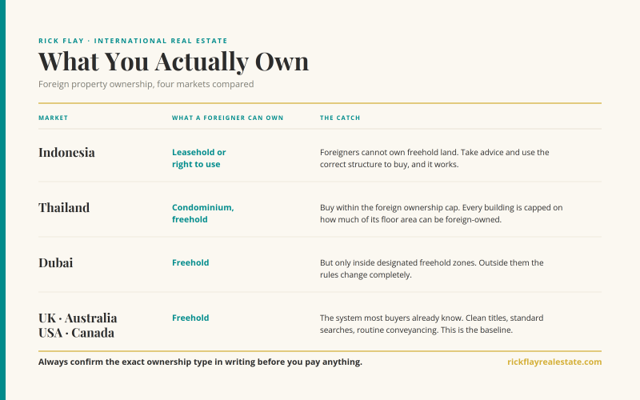
In Indonesia, foreigners cannot own freehold land. What you actually buy is a leasehold, or a right-to-use title. That is perfectly workable if you take advice and use the correct structure to buy. It is the buyers who improvise their own arrangement who lose their money.
In Thailand, a foreigner can own a condominium unit freehold. Buildings are capped on how much of the floor area can be foreign-owned, so availability is limited and it changes building by building. It is critical to check all the details before you buy.
In Dubai, foreigners can own freehold, but only in designated freehold zones. Outside them, the rules change completely.
None of these are reasons not to buy. I sell in all of these markets. They’re reasons not to buy on your own.
The four mistakes I see most
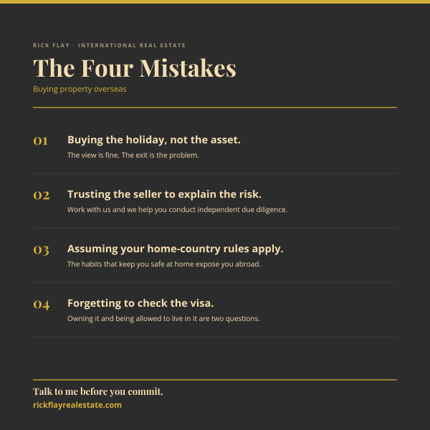
- Buying the holiday, not the asset.
You visit somewhere for two weeks in perfect weather, fall in love, and put a deposit down before you go home. The property is fine. The exit isn’t. Six years later you want to sell and you find out the resale market for that development is almost non-existent because everyone bought the same way you did.
- Trusting the person selling you the property to also advise you on the risk.
A sales agent works for the developer. That isn’t a scandal, it’s just how the industry is built. But it does mean the person explaining the ownership structure to you is not the person checking it for you. Those are two different jobs. Work with us and we help you conduct independent due diligence, so the structure gets checked by someone whose job is to check it.
- Assuming your home-country instincts transfer.
Australians in particular are used to a system that is unusually buyer-protective. Titles are clean, searches are standard, conveyancing is routine. Most of the world does not work like this. The habits that keep you safe at home are exactly the habits that expose you abroad.
- Forgetting to check whether you can actually live there.
You have found your dream property. Can you legally stay in it? Owning a home and having the right to live in the country are two separate questions, and the visa answer is different in every market. If you are not 100% sure, ask us before you buy, not after.
What “getting advice” should actually look like
Not a phone call after you’ve paid a reservation fee. Before.
The questions worth answering before you commit to anything:
- What am I actually buying? Freehold, leasehold, right-to-use, or shares in a company that owns it? How many years, and what happens at the end? What type of stays are allowed, long term or short term?
- Can I sell it, and to whom? Is there a resale market, or only a first-sale market?
- What does this do to my tax position In that country, and at home?
- If it’s an investment, who manages it, what does that cost, and what’s the realistic net yield after vacancy, fees and currency movement?
- What happens if I die owning it? Inheritance law is local, not personal.
If a seller can’t answer these calmly, in writing, that’s your answer.
The lifestyle is real. The shortcut isn’t.
I’m not here to talk anyone out of a life across two countries. I’ve built a business on helping people do exactly that: Bali, Phuket, Malaysia, Cyprus, Montenegro, the Maldives, France, Dubai, the UK, the USA, New Zealand and the Gold Coast.
What I’d say is this: the reason it works for the people it works for is that they treated it as a transaction in a foreign legal system that happened to come with a view, rather than a view that happened to come with paperwork.
If you’re thinking about it, have the conversation early. It costs nothing and it’s the single highest-return hour in the whole process.
Talk to me before you commit.rickflayrealestate.com · +61 404 497 335 |
Frequently asked questions
(This block should be marked up with FAQPage schema by the developer. It is what AI answer engines quote.)
Can foreigners own property overseas?
The answer is yes, but how you own it changes from country to country. Some markets, like Dubai’s freehold zones and parts of Europe, allow full foreign freehold ownership. Others, like Indonesia, use leasehold or right-to-use structures instead. Always confirm the exact ownership type before paying anything.
What is the biggest risk when buying property abroad?
The ownership structure, not the building. Most problems foreign buyers face come from holding the asset through an arrangement that isn’t legally secure in that country.
Do I need a lawyer in the country I’m buying in?
Yes, and an independent one. We can introduce you to local experts in the market you are buying in.
Will buying property overseas affect my tax at home?
Potentially yes, but everyone is different, so take advice. Rental income, capital gains and time spent in-country can all affect your tax residency and liability. Make sure you understand the 183-day rule and whether it applies to your situation. Get this checked before you buy, not at tax time.
Is buying overseas property a good investment?
If it is done correctly, yes, but only with a realistic view of net yield, resale liquidity and currency risk. A high headline yield in a market you can’t exit is not a good investment. And in the current world, diversification matters. Don’t put all your eggs in one basket.
How do I start?
Talk to someone who has sold in the market you’re considering, and who will tell you what’s wrong with it as readily as what’s right. Rick Flay has personally sold and rented out over 1,000 properties globally across Australia, Southeast Asia, Dubai, Europe and the UK.
Get in touch on WhatsApp, or by email.
+61 404 497 335
[email protected]



Join The Discussion