
Buying property in Vietnam is more restricted than most foreign buyers expect, because land belongs to the people and is managed by the state, so owners hold land use rights, not the land. Vietnam Briefing explains that eligible foreign individuals can own housing for up to 50 years, with one extension, and that apartment ownership is capped within each building. A draft revision released in September 2026 would go further and, as The Star reports, remove landed houses from what foreigners can own. Vietnam is not one of the five countries I know best, so this guide sets out the rules as reported and the questions to put to an independent local lawyer. I cover what foreigners can own, the limits, what the draft law changes and why I would rent first. If you are thinking of buying overseas, talk to me first, before you commit money, sign a contract or sell up at home.
Can Foreigners Own Property in Vietnam?
In a limited way, yes. Vietnam Briefing (6 March 2024, supported by Dezan Shira & Associates) says that two groups may own housing: foreign organisations and foreign individuals who are permitted to enter Vietnam. Individuals must hold a valid passport and be residing in Vietnam when they sign. They can acquire a home by purchase or lease-purchase from a project investor, by gift or by inheritance, but not in areas that require national defence and security assurance.
Land is different. Vietnam Briefing says land is collectively owned by the people and managed by the state, so owners hold land use rights permitted by law, not full ownership of the land. A Tuoi Tre article makes the same point from the retiree side: most expats cannot own property, especially land, so many rent.
What Are the Limits on Buying Property in Vietnam?
| Item | What Vietnam Briefing reports (March 2024) | What to check |
| Apartments | Foreigners may own up to 30 percent of the apartments in a building, applied within each block | Whether the building has reached its cap, and whether you qualify |
| Landed houses in projects | The Housing Law caps foreign ownership at 250 houses in an area the size of a ward, and the draft decree set a ward at 10,000 people | Whether this route still exists, because a 2026 draft would remove it |
| Security areas | Foreigners cannot buy in areas that require national defence and security assurance | Whether the project is in a restricted area |
| Term | Up to 50 years from the date of the certificate, extendable once for up to another 50 years | The exact term on your certificate |
Those figures come from an article about a draft decree, so the final rules may differ. Check them with an independent local lawyer for the exact building and the current date.
What Is the 2026 Draft Housing Law Changing?
On 2 October 2026, The Star reported that Vietnam’s Ministry of Construction was considering limiting foreign home ownership to apartments. The latest draft revision of the Law on Housing, released on 13 September, would remove the provisions that let foreigners own landed houses. The draft would keep the 30 percent cap per apartment building and a 50 year term with one possible extension of up to another 50 years, depending on the building’s remaining useful life.
The Ministry says the change keeps the law consistent with Resolution 21-NQ/TW, which bars land privatisation and the transfer of land-use rights to foreigners, except for overseas Vietnamese. It is a draft, not enacted law. If you are looking at a villa or townhouse in a project, ask your lawyer where the draft stands before you pay anything, and do not assume today’s rules will still apply when you complete.
How Does Buying Property in Vietnam Differ From Thailand?
Both countries restrict foreign ownership of land, but in different ways. In Thailand, foreigners can generally own a condominium unit freehold within the building’s 49 percent foreign quota, but cannot hold freehold land. My Phuket guide for foreign buyers and Bangkok condo guide explain the detail. In Vietnam, the apartment route is time-limited, with a reported 30 percent cap per building, which makes the term on the certificate an important question.
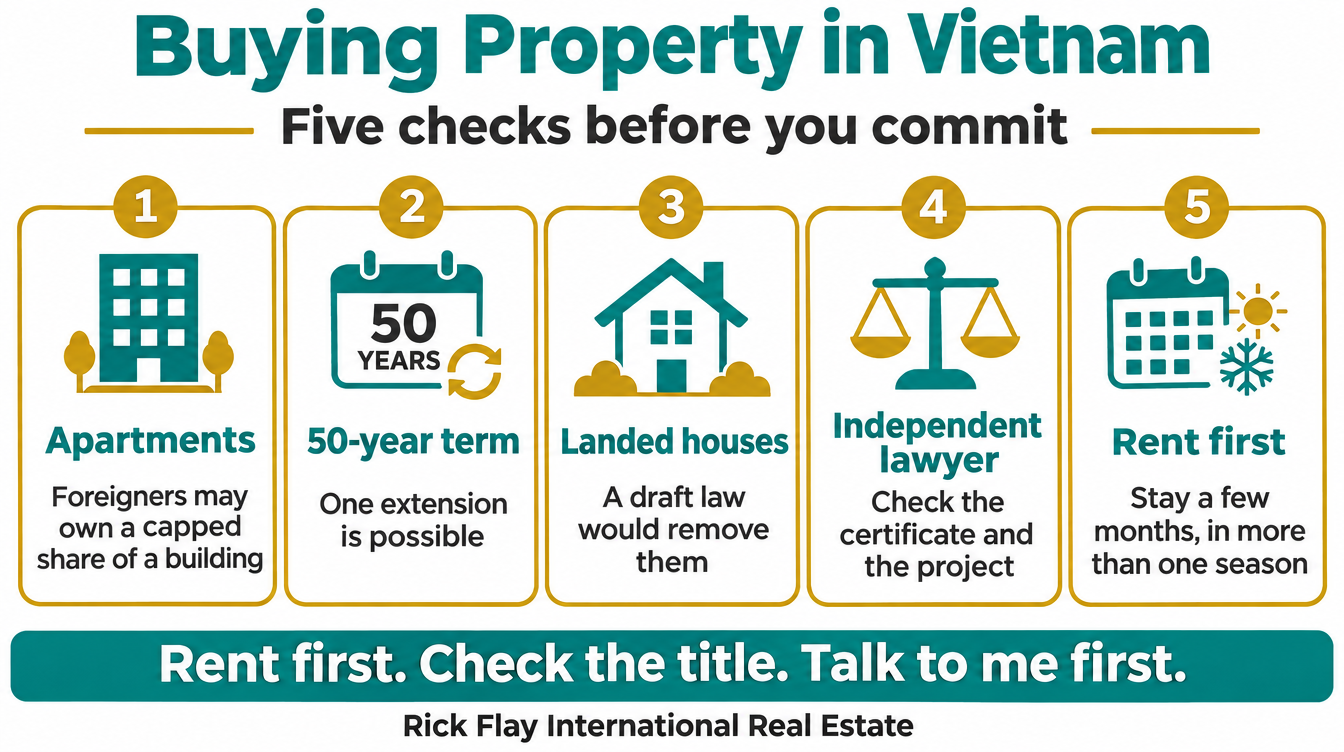
Infographic alt text: Infographic: five checks before buying property in Vietnam, from apartment caps to renting first
What Should You Check Before Buying Property in Vietnam?
- Rent in the exact area first, outside peak season, before you buy anything.
- Ask exactly what right you would hold and for how long, and see the certificate or the contract.
- Check the building’s or project’s foreign ownership cap and whether you qualify.
- Use an independent local lawyer, not one recommended by the developer or seller.
- Ask where the 2026 draft law stands if the property is a landed house.
- Confirm your residency route separately, because a purchase does not automatically give you the right to stay.
How Can I Help With the Whole Move?
The five countries I know best are Thailand, Bali, Malaysia, Dubai and Cyprus. If your country is not listed, such as Vietnam, ask me, because my network of agents covers more and I can introduce you to licensed local specialists, including an independent lawyer. I also help with the home you leave, and I say openly when a property is involved.
My job is to make sure you do not make an expensive mistake in the wrong order. Talk To Me First is my independent advisory service for people in Australia, New Zealand, the UK, the USA and Canada who are thinking of moving, retiring or investing overseas. It exists to help you make an informed decision before you commit money, sign a lease or sell up at home. I do not mind where you move. I care whether it is right for you.
I have moved countries five times, so I have been in your shoes. I have visited 92 countries and spent more than 30 years in international property, and I work with a network of more than 500 affiliate agents in 25 countries. I act as your strategist and coordinator. Regulated advice on tax, pensions, visas and legal matters comes from licensed specialists whom I introduce you to. I do not give that advice myself, and I will say so.
You choose the pace, from doing it yourself to having it done for you:
- The Talk To Me First Guide, a low-cost starting point if you want to plan the move yourself.
- A personal consultation, one hour with me on your situation.
- Your Overseas Move Plan, a written plan for one country if you prefer to do the move yourself.
- The Full Mentoring Package, with me beside you through the move, if you want it done for you.
- Property help to buy or rent in your new country, or to sell or rent out the home you leave, through Rick Flay International Real Estate. I will always say so openly when a property is involved.
- Introductions to licensed specialists in migration, legal, tax, foreign exchange, insurance and healthcare.
Tell me your budget, whether you want to rent or buy, your timing and which places you are considering. Talk to me first, and we will work out the right order of steps before you commit to anything. Get in touch or message me on WhatsApp on +61 404 497 335.
Frequently Asked Questions
Can foreigners buy property in Vietnam?
Eligible foreigners can own housing, mainly apartments, for a limited term and within caps. Land belongs to the state, and a 2026 draft law would remove landed houses from what foreigners can own.
Can foreigners own land in Vietnam?
No. Vietnam Briefing says land is managed by the state and owners hold land use rights, not full ownership of the land.
How long can a foreigner own a home in Vietnam?
Vietnam Briefing reports up to 50 years from the date of the certificate, with one extension of up to another 50 years. Check the exact term on your certificate.
Is there a limit on how many apartments foreigners can own in a building?
Vietnam Briefing reports a cap of 30 percent of the apartments in a building, applied within each block. Ask your lawyer whether the building has reached it.
Is Vietnam’s housing law changing?
A draft revision released on 13 September 2026 would remove landed houses from what foreigners can own, according to The Star. It is a draft, not law, so check where it stands.
Can you help with visas and residency?
Yes. Through Talk To Me First I introduce you to licensed specialists who handle the visa and tax detail, and I help you plan the move. I do not give visa or tax advice myself.
About the author. Rick Flay has more than 30 years of experience in real estate, with over 1,000 properties sold and rented across international markets. Rick Flay International Real Estate helps clients buy, sell and relocate through an international affiliate network of 500+ agents in 20+ countries.
Property, tax, health and immigration rules change, and the right decision depends on your circumstances. Nothing in this article is financial, legal, tax or immigration advice. Take independent professional advice before buying or moving.
© The data shown on this website and any other written communication has been offered by third parties and is assumed to be correct. The sale of the properties is managed by Rick Flay Real Estate, Australia. Our company does not guarantee their veracity or accept any responsibility for any errors. The offer may be subject to errors, price changes, omissions and/or withdrawal from the market without prior notice. Prior to purchase clients are advised to check with their legal advisors on all details pertaining to the sale/purchase. The information does not form any part of any contract for sale. We always recommend that you take independent, legal, financial and taxation advice. Additionally some photos, plans, specifications are indicative/illustrative only and may have been created by AI.


Join The Discussion