
Buying property abroad as an American is straightforward, and US law places no restriction on it. What matters is the destination country: whether foreigners can own outright, how the purchase has to be structured, and how you pay. Most US banks do not lend against property overseas, so American buyers typically pay cash or release equity from a home in the US. The purchase itself is not an IRS reporting event, but the foreign bank account used to pay for it or to collect rent can be, and rental income is taxable in the US. In our markets, an American can own a condominium in Thailand freehold, buy through a lease or company structure in Bali, and qualify for permanent residency through a new build in Cyprus. Entry points start from about USD 85,000. Here is how it works market by market, and what to set up before you sign.
Can Americans Buy Property Overseas?
Yes. The United States does not restrict its citizens or residents from owning property abroad, so the question is always what the other country allows. In each market we work in, an American generally buys on the same basis as any other overseas buyer, and the differences between countries are far bigger than any difference between nationalities.
That makes the first decision a choice of market rather than a legal hurdle. Some countries let you own an apartment outright in your own name. Others do not allow foreign freehold at all and use leases or company structures instead. Knowing which you are dealing with before you fall for a specific property saves a great deal of time.
Our guide to the mistakes to avoid when buying property overseas covers the pitfalls that apply whichever country you choose.
Which Markets Let Americans Own Property Outright?
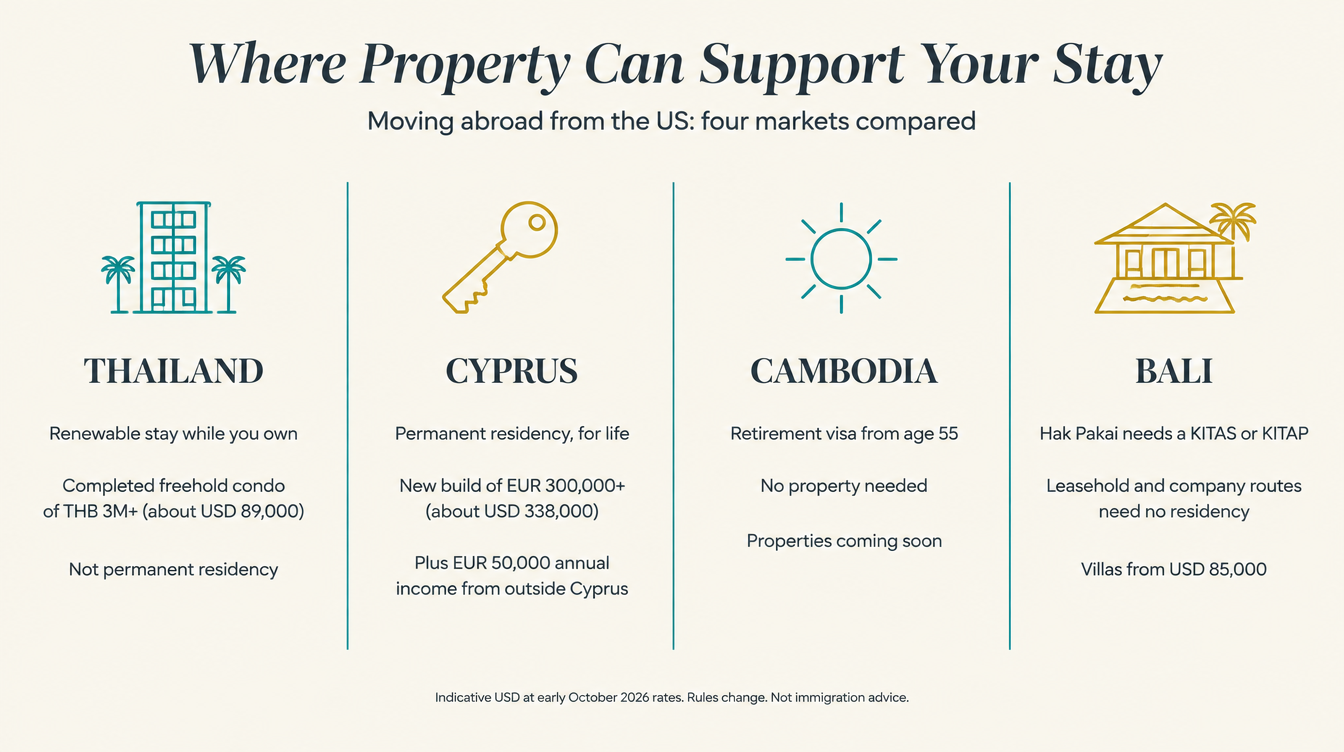
For anyone buying property abroad as an American, the first filter is ownership. Here is how it works in the markets where we currently have property, with the lowest listed price in each, converted to US dollars.
| Market | How an American can own | Listed in | Entry point on our listings |
| Thailand, Bangkok | Condominium unit freehold, in your own name, within a 49 percent foreign quota per building | Thai baht | About USD 125,000 (THB 4,190,000) |
| Thailand, Phuket | Same condominium route. Villas and land use a lease or a company, since foreigners cannot own land | Thai baht and US dollars | About USD 85,000 (THB 2,850,000) |
| Bali | No foreign freehold. Leasehold, a Right to Build held through a foreign owned company, or Hak Pakai if you hold Indonesian residency | US dollars | From USD 85,000 |
| Cyprus, Paphos | Residential property for non EU buyers. A new build of EUR 300,000 or more can support permanent residency | Euros | About USD 219,000 (EUR 195,000) |
| Cambodia | Condominium units above the ground floor, within a 70 percent building quota. Foreigners cannot own land | US dollars | Coming soon, expected before the end of the year |
Baht and euro prices are converted at about 33.6 baht and 1.125 US dollars per euro, early October 2026. Currency moves, so treat the dollar figures as indicative.
Have a look at this one bedroom condominium in Eastern Bangkok, this villa with a private pool in Ubud, this lakefront studio in Bang Tao, Phuket and this studio in Paphos to see what the entry points look like.
A few notes on each market:
- Foreigners can own a condominium unit outright, but not land, so apartments are the straightforward route. We cover the ownership rules in detail in our guides to buying a condo in Bangkok and buying property in Phuket.
- Indonesia reserves freehold for its own citizens, so the structure you choose matters more here than anywhere else in our range. Our guide to buying a villa in Bali explains the options.
- Americans are non EU buyers, and the residency route depends on buying a qualifying new build, so check the property type before you fall for it. See our Cyprus guide.
- Our first properties in Phnom Penh and Siem Reap are expected before the end of the year, priced in US dollars. You can read the introduction and register your interest.
How Do Americans Pay for Property Abroad?
Most US banks do not offer mortgages on property overseas, so the usual routes are different from buying at home. The common ones are paying cash, releasing equity from a property you own in the US, arranging finance in the country you are buying in where a local lender will lend to non residents, and paying a developer in stages on a new build.
If you plan to borrow against a US home, check the terms with your lender before you rely on it. Whichever route you choose, funds are normally sent by international wire from a US account, and some countries ask for evidence that the money arrived from abroad. Thailand, for example, requires purchase funds to come in from overseas in a foreign currency, with a Foreign Exchange Transaction form for transfers of USD 50,000 or more.
Our Bali listings are priced in US dollars, which removes one conversion from the process. For markets priced in baht or euros, the exchange rate between your purchase agreement and your transfer is worth planning for.
What Does the IRS Expect From American Property Buyers Abroad?
Less than most people fear when buying property abroad as an American. US citizens and residents are taxed on worldwide income, but buying a property abroad is not an IRS reporting event, and a property you own directly is not reported on the two main foreign asset filings, the FBAR and Form 8938.
Three things are worth knowing before you sign:
- Foreign bank accounts. If the combined balance of your foreign financial accounts goes over USD 10,000 at any time in the year, an FBAR is required. That includes an account opened to pay for the property or collect rent, which is why it pays to plan the payment route rather than discover the requirement afterwards.
- Ownership through a company. Holding property through a foreign company or similar entity can bring a separate Form 8938 requirement, depending on the thresholds. This is relevant in markets like Bali, where villas are often held through a company.
- Rental income. Rent from a property abroad is reported on your US return, on Schedule E, and the foreign earned income exclusion does not apply to it.
I do not give tax advice, and the right answer depends on your own situation, so speak to a US cross border tax professional before you buy. The IRS explains the foreign account filings in its fact sheet on offshore income and filing information.
Can Americans Buy Property in Australia?
Yes, with limits. Foreign persons, which includes most Americans, are currently barred from buying established dwellings in Australia until 30 June 2029, but can buy new dwellings and vacant residential land with foreign investment approval. The ATO sets out the types of property a foreign person can buy, and our Gold Coast buyer’s guide covers how it works in practice.
What Should You Do First When Buying Property Abroad as an American?
- Decide what the property is for: income, a holiday base or a place to live. It decides which market fits.
- Check the ownership route in your chosen market before you shortlist anything.
- Decide how you will pay, and set up the payment route with a US cross border tax professional rather than after the transfer.
- Appoint an independent local lawyer to check title, structure and contract.
- Talk to me first, so the shortlist matches your budget and your plans.
Frequently Asked Questions
Can Americans buy property abroad?
Yes. US law does not restrict Americans from owning property overseas, so the rules that apply are those of the country you are buying in. In our markets, Americans can own a condominium freehold in Thailand, buy through a lease or company structure in Bali, and buy residential property in Cyprus.
Can I get a US mortgage to buy property overseas?
Rarely. Most US banks do not offer mortgages on property outside the United States, so American buyers typically pay cash, release equity from a US property, arrange finance in the destination country, or pay a developer in stages. Check the terms with your lender before relying on a home equity loan.
Do I have to report foreign property to the IRS?
Owning a property directly is not itself reported on the FBAR or Form 8938. But a foreign bank account used to pay for it or collect rent can trigger an FBAR if combined foreign balances exceed USD 10,000 at any time in the year, and ownership through a foreign company can trigger Form 8938. Take advice from a US cross border tax professional.
Do I pay US tax on rental income from property abroad?
Yes. US citizens and residents are taxed on worldwide income, so rent from an overseas property is reported on your US return on Schedule E. The foreign earned income exclusion does not apply to rental income. Foreign taxes paid may be creditable, so a US cross border tax professional can show you how it works out.
How much does it cost to buy property abroad as an American?
Among our current listings, entry points start from about USD 85,000 in both Bali and Phuket, about USD 125,000 in Bangkok and about USD 219,000 in Paphos, Cyprus. Prices are as listed and converted at early October 2026 rates, and purchase costs vary by country.
Can Americans buy property in Australia?
Yes, with limits. Foreign persons, including most Americans, cannot currently buy established dwellings in Australia until 30 June 2029, but can buy new dwellings and vacant residential land with foreign investment approval.
Talk to me first
Buying property abroad as an American comes down to choosing the right market, the right structure and the right payment route before you commit. Tell me your budget and what you want the property to do, and I will show you what fits. Get in touch, or message me on WhatsApp on +61 404 497 335 and we will find a time that works across the time difference.
About the author. Rick Flay has more than 30 years of experience in real estate, with over 1,000 properties sold and rented across international markets. Rick Flay International Real Estate works with an international network spanning South East Asia, Dubai, Europe, the USA, the UK and New Zealand, helping private buyers purchase lifestyle and investment property abroad.
Ownership, tax and immigration rules in each country change, and US tax rules depend on your own circumstances. Nothing in this article is financial, legal, tax or immigration advice. Always take independent professional advice, including from a US cross border tax professional.
© The data shown on this website and any other written communication has been offered by third parties and is assumed to be correct. The sale of the properties is managed by Rick Flay Real Estate, Australia. Our company does not guarantee their veracity or accept any responsibility for any errors. The offer may be subject to errors, price changes, omissions and/or withdrawal from the market without prior notice. Prior to purchase clients are advised to check with their legal advisors on all details pertaining to the sale/purchase. The information does not form any part of any contract for sale. We always recommend that you take independent, legal, financial and taxation advice. Additionally some photos, plans, specifications are indicative/illustrative only and may have been created by AI.




Join The Discussion