
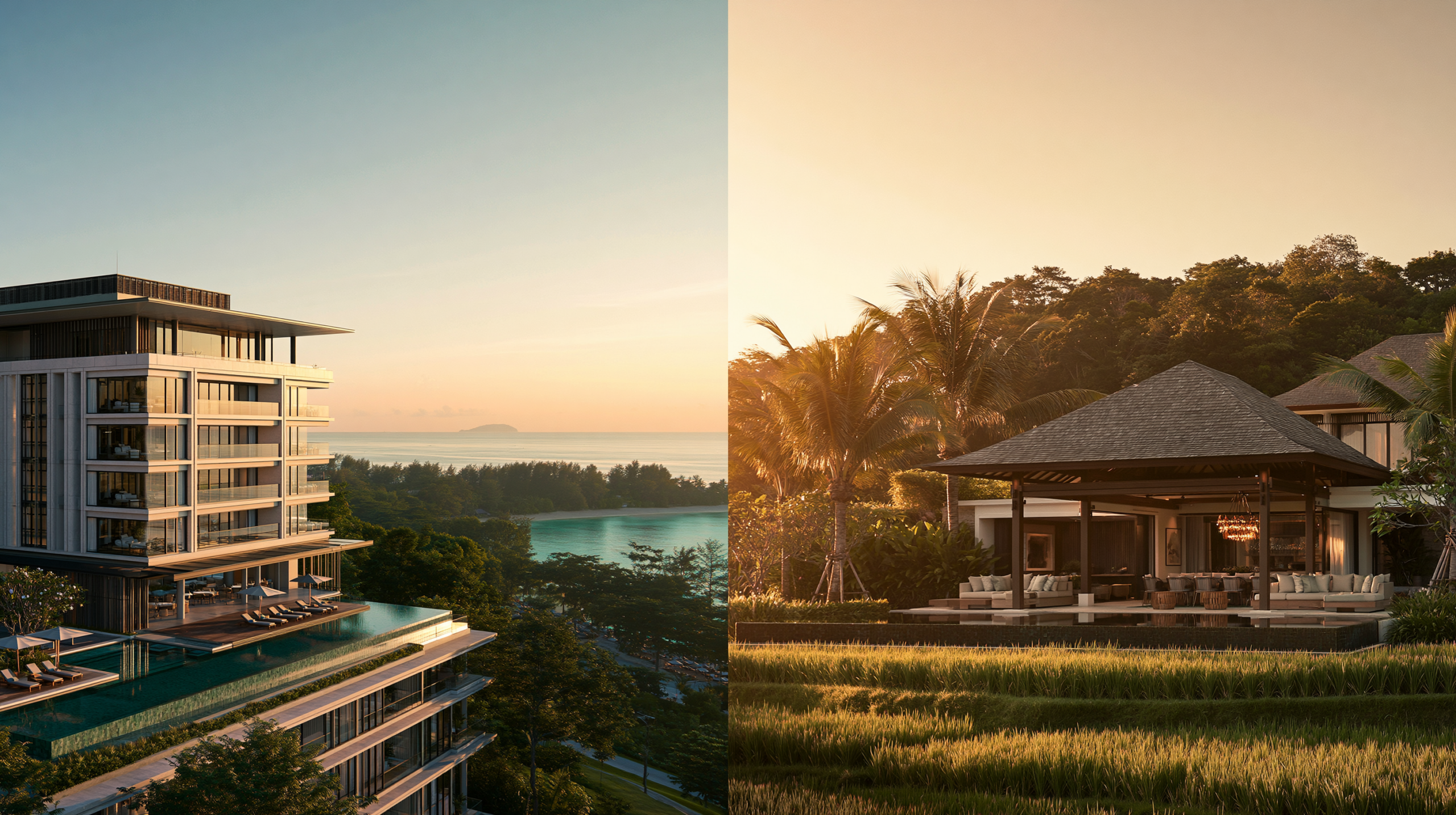
Bali or Phuket is one of the most common questions I get from buyers looking at Southeast Asia, and there is a genuine answer rather than a diplomatic one. The single biggest difference is ownership. In Phuket, a foreign buyer can own a condominium unit outright, freehold, registered in their own name. In Bali, no foreigner can hold freehold title to anything, so every purchase runs through a lease or a company structure. Both countries prohibit foreign land ownership entirely, which means the gap between them is widest at the apartment level and much narrower for villas. That one distinction shapes how the purchase is structured and what you actually hold at the end of it. Neither market is better in the abstract. They suit different buyers with different priorities, and the right choice usually becomes obvious once you know which trade off matters most to you.
Can Foreigners Own Property Outright in Bali or Phuket?
In Phuket, yes, if you buy a condominium. Section 19 of Thailand’s Condominium Act allows foreign nationals to own condo units in their own name, with full freehold title, provided foreign ownership across the building stays within 49 percent of its total floor area. You appear on the title deed. You are the owner in the ordinary sense of the word.
In Bali, no. Indonesia’s Basic Agrarian Law of 1960 reserves Hak Milik, the country’s only true freehold title, for Indonesian citizens. Foreign buyers instead hold a leasehold, a Right of Use permit called Hak Pakai, or a Right to Build known as HGB, held through a foreign owned Indonesian company called a PT PMA.
Which of those suits you depends on what you intend to do with the property, and the distinction matters more than most buyers realise. Hak Pakai requires you to hold Indonesian residency through a KITAS or KITAP, so it suits people who genuinely intend to live in Bali. HGB through a PT PMA requires no residency and is the structure that allows you to let the property out properly, which makes it the usual route for investors. For most buyers treating the purchase as an investment rather than a home, HGB is the better fit.
This is the point most comparison articles skate over, and it is worth understanding before anything else. It does not make Bali a lesser purchase. Thousands of foreign owners hold Bali property perfectly securely, and the structures are well established and well understood. It does mean the two markets ask different things of you at the point of purchase.
What Ownership Structures Are Available in Each Market?
| Phuket, Thailand | Bali, Indonesia | |
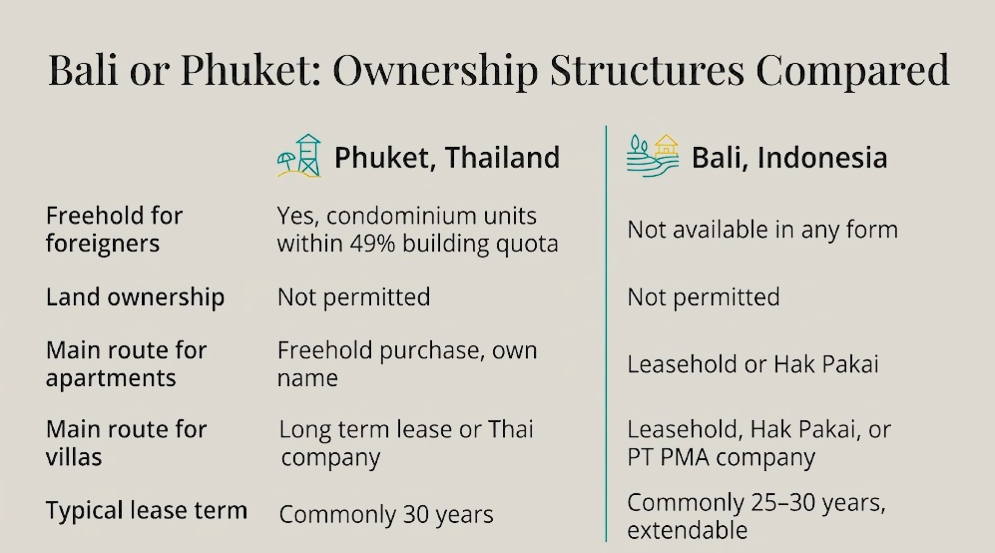
| Freehold for foreigners | Yes, condominium units only, within the 49 percent building quota | Not available in any form |
| Land ownership | Not permitted for foreign nationals | Not permitted for foreign nationals |
| Main route for apartments | Freehold purchase in your own name | Leasehold, or Hak Pakai if you hold Indonesian residency |
| Main route for villas | Registered long term lease, or a Thai company holding the land | Leasehold, or HGB through a PT PMA company |
| Best suited to investors | Freehold condominium, no company needed | HGB through a PT PMA, no residency needed and lets you rent the property out properly |
| Best suited to residents | Freehold condominium, or a lease on a villa | Hak Pakai, which requires a KITAS or KITAP residency permit |
| Typical term if leasing | 30 years in the first registered grant, with renewal terms commonly built into the agreement | 25 to 30 years in the first grant, and HGB commonly extendable to a combined total of around 80 years |
Both markets prohibit foreign land ownership, so the villa position is more similar than buyers expect. The divergence is at the apartment and condominium level, where Thailand offers something Indonesia does not.
Which Market Is Better for Rental Income?
Both are tourism driven markets with year round demand, and both support strong rental performance in the right development. What differs is the shape of that demand.
Bali attracts a large long stay population alongside holiday visitors, including remote workers and seasonal residents, which supports both nightly rental and multi month tenancies. Phuket skews more toward established resort and holiday rental patterns, with a large base of professionally run developments that have rental programmes attached.
Indicative returns we are currently seeing sit at around 6 percent in Phuket and between 10 and 15 percent in Bali. Those are indicative rather than guaranteed, and what a specific property actually delivers depends on the development, the management and the terms of the rental agreement. Talk to me first and I will show you the numbers on properties that are actually available now rather than a general range.
Which Is Easier to Sell Later?
Honestly, the resale picture in both markets is still relatively untested, because meaningful overseas investment in each is comparatively recent. Neither has the decades of foreign resale history you would find in more mature markets, so anyone telling you confidently how a resale will go in either place is guessing.
What does hold is that the same fundamentals apply here as everywhere else in the world. Location, the condition of the property, the type of property, the asking price and the market conditions at the time of sale are what determine how a sale goes. A well located, well maintained property bought at a sensible price tends to sell in both markets, and a poorly located one tends to struggle in both.
The one structural point worth knowing is that where you hold a lease rather than freehold, the remaining term forms part of what a future buyer assesses. That is not a reason to avoid leasehold, it is a reason to understand the term and the extension provisions at the point of purchase rather than years later.
Can You Get Residency Through Buying in Bali or Phuket?
Both countries offer property linked long stay routes, though neither works the way a European residency by investment programme does, and the rules in this area change more often than property law does.
Thailand introduced an investment based extension of stay route tied to qualifying freehold condominium purchases, which is covered in our Phuket foreign buyer’s guide. Indonesia operates residency permits including a second home visa pathway, and holding a KITAS or KITAP is what unlocks the Hak Pakai title option for a foreign buyer in Bali.
Because immigration requirements move independently of property rules, I would rather confirm the current position for your situation directly than publish a threshold that may be out of date by the time you read it.
So Which Should You Buy In?
It comes down to what you want the property to do for you.
- Some buyers will prefer Phuket for the ownership structure. A freehold condominium in your own name is about as simple as ownership gets for a foreign buyer in Southeast Asia, and for some people that simplicity is worth a lot.
- If the property itself is the point, a private villa with land around it in a place you actively want to spend time, Bali offers a depth and variety of that kind of stock that Phuket does not match.
- On cost, Bali is generally the cheaper of the two, both to buy into and to live in day to day, which matters if you intend to spend real time there.
- Phuket offers something Bali cannot, which is a base for exploring the rest of Thailand and its islands. For buyers who want a launch point rather than a single destination, that is a genuine advantage.
- Both have large, well established international communities, so neither leaves you isolated. Phuket’s expatriate population, including a very substantial Russian and Ukrainian community, is every bit as significant as Bali’s.
Plenty of my buyers end up in the market they did not expect once they see what their budget actually buys in each. Have a look at what is currently available in Bali and Thailand, or compare something like this two bedroom apartment in Canggu against this three bedroom apartment in Bang Tao to see how the two markets present at a similar level.
Frequently Asked Questions
Can foreigners own property in Bali or Phuket?
In Phuket, foreigners can own condominium units outright with freehold title, subject to the 49 percent foreign quota per building. In Bali, foreigners cannot hold freehold title and instead use leasehold, Hak Pakai, or a PT PMA company structure.
Is Bali or Phuket better for property investment?
Phuket offers freehold condominium ownership in your own name. Bali offers greater variety of villa stock, lower entry costs and indicatively higher rental returns. Which suits you depends on whether you value the ownership structure or the property and the returns more.
What rental returns can you expect in Bali or Phuket?
Indicatively, around 6 percent in Phuket and 10 to 15 percent in Bali, though these are indicative rather than guaranteed. Actual performance depends on the specific development, the management arrangement and the rental terms, which is worth reviewing property by property.
Should I use Hak Pakai or HGB to buy in Bali?
It depends on whether you are buying a home or an investment. Hak Pakai requires Indonesian residency through a KITAS or KITAP, so it suits people who will actually live there. HGB through a PT PMA company needs no residency and allows you to let the property out properly, which makes it the usual choice for investors.
Can you buy land in Bali or Phuket as a foreigner?
No, neither country permits foreign nationals to own land. Both markets require a lease or a properly structured local company for any purchase involving land, which is why villa purchases look more similar across the two than apartment purchases do.
Is leasehold in Bali safe?
A properly registered leasehold, drafted by an independent notary with the underlying title verified, is a well established structure used by many foreign owners. What should be avoided is a nominee arrangement, where an Indonesian citizen holds freehold title on a foreigner’s behalf, as those are unenforceable.
Which is cheaper, Bali or Phuket?
Bali is generally cheaper both to buy into and to live in. That said, headline entry prices often reflect the smallest unit in a development rather than a realistic comparison, so the more useful exercise is looking at what a specific budget buys in each market right now.
Talk to me first
Deciding between two markets is much easier with real properties in front of you than in the abstract. Tell me what you are looking for and I will show you what your budget actually buys in each, along with an honest view of which one fits your plans.
About the author. Rick Flay has more than 30 years of experience in real estate, with over 1,000 properties sold and rented across international markets. Rick Flay Real Estate works with an international network spanning South East Asia, Dubai, Europe, the USA, the UK and New Zealand, helping private buyers purchase lifestyle and investment property abroad.
Ownership, tax and immigration rules in both countries change, and the right structure depends on your own circumstances. Always take independent legal, financial and taxation advice before committing to a purchase.
© The data shown on this website and any other written communication has been offered by third parties and is assumed to be correct. The sale of the properties is managed by Rick Flay Real Estate, Australia. Our company does not guarantee their veracity or accept any responsibility for any errors. The offer may be subject to errors, price changes, omissions and/or withdrawal from the market without prior notice. Prior to purchase clients are advised to check with their legal advisors on all details pertaining to the sale/purchase. The information does not form any part of any contract for sale. We always recommend that you take independent, legal, financial and taxation advice. Additionally some photos, plans, specifications are indicative/illustrative only and may have been created by AI.


Join The Discussion