Buying Property in Montenegro: Costs, Fees & Residency Considerations
Montenegro property buying costs are among the more transparent in the region, which is part of what makes the market so approachable for international buyers. On a resale purchase, expect a progressive transfer tax plus notary and legal costs, generally landing somewhere in the region of 4 to 8 percent above the purchase price. On a new build bought directly from a developer, no transfer tax applies at all, because VAT is normally already built into the advertised price. Ownership costs afterwards are genuinely light. There is also a property-linked residency pathway worth understanding if long stays are part of your plan, and we can walk you through all of it before you commit to anything.
What Are the Montenegro Property Buying Costs on a Resale?
Since 1 January 2024, Montenegro has applied a progressive real estate transfer tax on resale purchases, replacing the previous flat rate. The rate rises in three bands: 3 percent on value up to EUR 150,000, 5 percent on the portion between EUR 150,000 and EUR 500,000, and 6 percent on anything above EUR 500,000. This is calculated on the tax authority’s assessed value, not simply the figure written on your contract, which is a distinction worth understanding early.
Importantly, there is no separate or higher rate for foreign buyers. You pay exactly what a Montenegrin citizen pays on the same property, which is consistent with the country’s broader approach to international ownership.
Do You Pay Transfer Tax on a New Build in Montenegro?
No. When you buy a new build directly from a developer as the first transfer of ownership, transfer tax does not apply. Instead, VAT at 21 percent applies to the building element of the price, and in practice it is normally already included in the advertised figure rather than added on top.
This makes new build purchases surprisingly clean from a cost perspective, since the headline price is often much closer to your true all-in figure. The one thing genuinely worth doing is getting written confirmation that the quoted price is VAT inclusive before you sign, and that is exactly the sort of check we handle as a matter of course for our buyers.
What Other Fees Should You Budget For?
Every purchase in Montenegro must be notarised, and notary fees are set by a regulated state tariff rather than negotiated, which keeps them predictable and capped. In most transactions they come to well under 1 percent of the purchase price.
Beyond that, budget for legal representation and due diligence, cadastre registration, and any certified translation you need. These vary depending on the property and how much investigation it warrants, particularly on older coastal properties where title history deserves closer attention. Rather than quote you a figure that may not match your situation, we would rather look at the specific property with you and give you a real number.
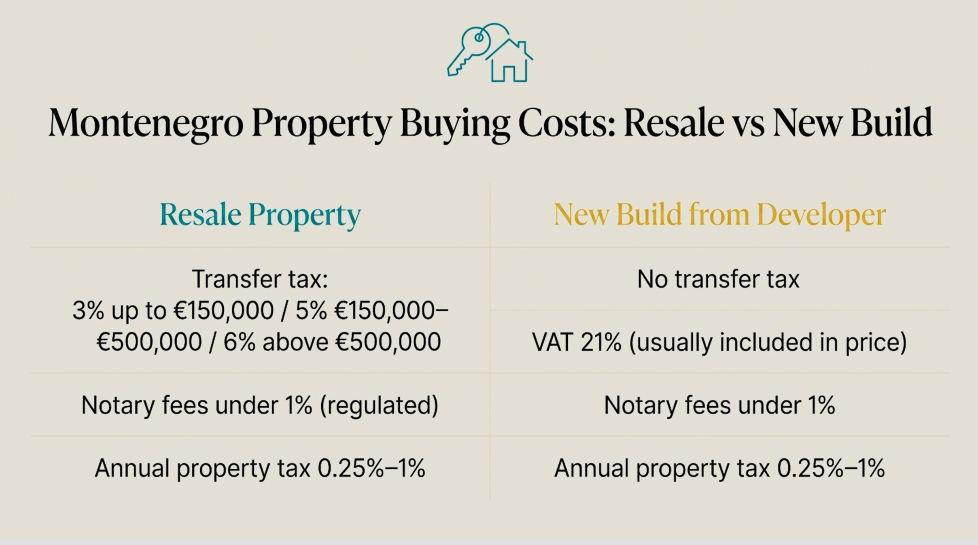
Montenegro Property Buying Costs at a Glance
| Cost | Resale property | New build from developer |
| Transfer tax | 3% up to EUR 150,000, 5% from EUR 150,000 to EUR 500,000, 6% above EUR 500,000 | Not applicable |
| VAT | Not applicable | 21%, normally already inside the developer’s advertised price |
| Notary fees | Regulated state tariff, capped, typically under 1% | Regulated state tariff, capped, typically under 1% |
| Legal and due diligence | Varies by complexity, talk to us | Varies by complexity, talk to us |
| Annual property tax | 0.25% to 1% of assessed value | 0.25% to 1% of assessed value |
What Are the Ongoing Costs of Owning Property in Montenegro?
Holding costs in Montenegro are modest. The annual municipal property tax generally runs between 0.25 and 1 percent of the assessed value, with the exact rate set locally and varying by municipality and property type. Rental income and capital gains are each taxed at 15 percent.
There is no separate wealth tax or recurring national levy on the property itself, which is one reason Montenegro compares well against other Adriatic and Mediterranean markets on total cost of ownership rather than just entry price.
Can Buying Property Get You Residency in Montenegro?
Yes, property ownership supports an application for temporary residence, though the rules changed at the start of 2026 and it is worth being precise about what the pathway is and is not. Non-EU, non-EEA and non-Swiss nationals applying on the basis of property ownership must now hold real estate with a tax assessed value of at least EUR 150,000.
The critical detail, and the one that catches people out, is that the qualifying figure is the value the tax authority assigns when calculating transfer tax, not the price on your purchase contract and not the listing price. Those can differ meaningfully. Checking the assessed value before you buy, rather than after, is the single most useful thing you can do if residency is part of your reason for purchasing, and it is a check we can help you make early.
This threshold was set by amendments published in the Official Gazette of Montenegro (No. 003/2026) on 9 January 2026, taking effect on 17 January 2026. The change was widely reported across the investment migration sector, including by IMI Daily, and buyers who already held property based residence before that date are generally grandfathered under the previous rules.
What Does Montenegro Residency by Property Actually Give You?
The permit granted is a temporary residence permit valid for one year, renewable annually for as long as you continue to meet the conditions, including maintaining ownership and keeping property tax obligations settled. Applicants generally need to demonstrate both ownership and genuine use of the property, alongside sufficient financial means and valid health cover.
It is worth being clear that this is not permanent residency and not citizenship, and it does not on its own grant the right to work or run a business in Montenegro, which fall under separate permit regimes. For buyers who want a straightforward, renewable basis for spending extended time in the country, it is a genuinely useful pathway. For anyone whose plans depend on working locally, it is worth a proper conversation about which route actually fits.
Montenegro’s former citizenship by investment programme, which some older articles still reference, closed at the end of December 2022 and is no longer available. Anyone telling you otherwise is working from outdated information.
How Do These Costs Compare Across the Buying Process?
Montenegro’s process typically runs two to four months from agreed offer through to registered ownership, and the costs above fall at predictable points along the way rather than arriving as surprises. Transfer tax is filed and paid shortly after the sale contract is signed, notary fees are settled at certification, and registration follows at the cadastre.
For context on how Montenegro’s structure compares with other markets, our guide to buying property in Montenegro for international buyers covers the ownership framework itself, and is worth reading alongside this one.
Frequently Asked Questions
How much does it cost to buy property in Montenegro?
On a resale, budget roughly 4 to 8 percent above the purchase price, covering progressive transfer tax of 3 to 6 percent plus notary, legal and registration costs. On a new build, VAT at 21 percent is normally already inside the developer’s price, so additional costs are typically lower.
What is the property transfer tax in Montenegro?
Since January 2024 it has been progressive: 3 percent up to EUR 150,000, 5 percent between EUR 150,000 and EUR 500,000, and 6 percent above EUR 500,000, calculated on the tax authority’s assessed value. There is no higher rate for foreign buyers.
Do foreigners pay more tax when buying property in Montenegro?
No. Foreign buyers pay the same transfer tax, VAT and annual property tax as Montenegrin citizens. There is no foreign buyer surcharge.
Can I get residency in Montenegro by buying property?
Yes, temporary residence. Since 17 January 2026, non-EU, non-EEA and non-Swiss nationals need property with a tax assessed value of at least EUR 150,000. The permit is valid for one year, renewable, and does not grant work rights or permanent residency.
Is the EUR 150,000 threshold based on what I paid for the property?
No, and this is the most common misunderstanding. It is based on the value the tax authority assigns when assessing transfer tax, which can differ from your contract price. Worth checking before you buy rather than after.
Does Montenegro still offer citizenship by investment?
No. That programme closed at the end of December 2022. The current property linked route is temporary residence only, which is a different thing with different conditions.
Get in touch
Want a real cost breakdown on a specific Montenegro property, including whether it clears the residency threshold? Enquire about buying property in Montenegro and talk to us first.
Explore current opportunities on the Montenegro property page.
Book a meeting with Rick directly Here.
© The data shown on this website and any other written communication has been offered by third parties and is assumed to be correct. The sale of the properties is managed by Rick Flay Real Estate, Australia. Our company does not guarantee their veracity or accept any responsibility for any errors. The offer may be subject to errors, price changes, omissions and/or withdrawal from the market without prior notice. Prior to purchase clients are advised to check with their legal advisors on all details pertaining to the sale/purchase. The information does not form any part of any contract for sale. We always recommend that you take independent, legal, financial and taxation advice. Additionally some photos, plans, specifications are indicative/illustrative only and may have been created by AI.



Join The Discussion